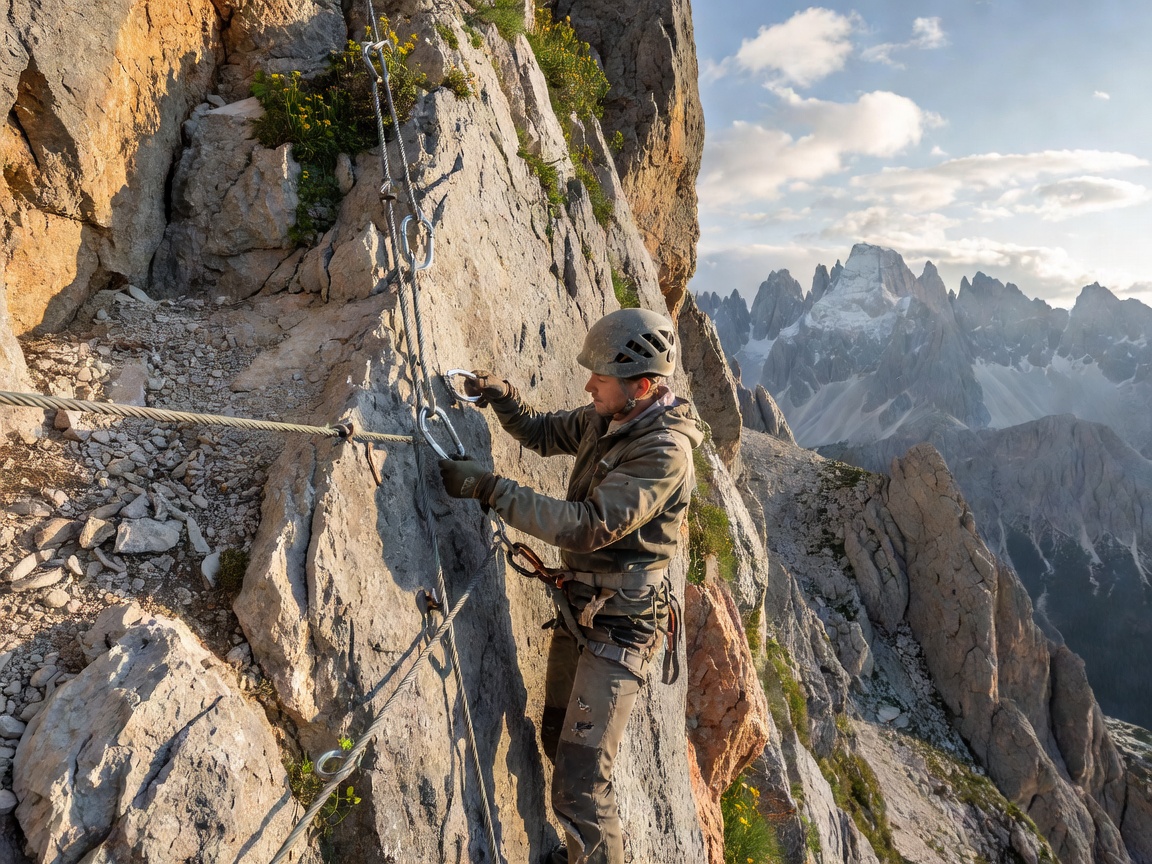
The 48-Hour Tactical Deployment
Fly into Venice Marco Polo on Friday afternoon. Pick up an all-wheel-drive hire vehicle and drive directly north along the A27 motorway through Longarone to Cortina d'Ampezzo. Drive time runs 1 hour 50 minutes. Check into base camp in the Boite Valley, collect pre-arranged technical via ferrata kits from an alpine equipment shop, and prep your daypack before turning in.
Saturday morning starts at 06:30. Hit the Michielli Strobel route on Punta Fiames. It delivers 1,000 metres of elevation gain from the valley floor with roughly 400 metres of pure cable scrambling. The exposure over the Ampezzo basin is sheer, constant, and clean. You finish the descent scree run by 14:00, refuel in town with carbohydrate-dense mountain fare, and prep Sunday's assault on the Cristallo range.
Sunday morning demands early commitment to the Ivano Dibona high ridge. Ride the Rio Gere chairlift up to Son Forca, then ascend to Forcella Staunies. You traverse across hanging suspension bridges, wooden World War I garrison catwalks, and exposed steel ladders at 2,900 metres elevation. Descend through Val Padeon by 15:30, load your gear, and return to Venice Marco Polo for flights departing after 20:30.
Route Comparison & Technical Criteria
| Route Designation |
Peak Elevation |
Vertical Gain |
UIAA / CAI Grade |
Commitment Window |
| Michielli Strobel (Punta Fiames) |
2,240 m |
1,010 m |
Difficile (C) |
5h 30m round-trip |
| Ivano Dibona (Monte Cristallo) |
2,985 m |
450 m up / 1,400 m down |
Media Difficoltà (B) |
7h 00m complete traverse |
| Giovanni Lipella (Tofana di Rozes) |
3,225 m |
1,180 m |
Difficile (C/D) |
8h 00m endurance circuit |
Mandatory Gear Specifications
Never enter a Dolomite iron way without certified safety equipment compliant with European standards. Rocks fall constantly from parties moving on tiers above you. Alpine weather flips within 30 minutes when convective cloud banks sweep down from the Austrian border.
Harness & Energy Absorber
You need an EN 958 certified progressive-tear via ferrata lanyard paired with a clean sit harness. Standard climbing slings or knotted static cord will snap under factor-2 or higher fall forces generated on rigid steel rungs. Confirm double-action automatic locking gates on both carabiners.
Impact Shell & Layering
Wear an EN 12492 climbing helmet at all times, starting directly from the approach scree. Pack a 3-layer hardshell jacket with sealed seams, reinforced leather-palm belay gloves to handle frayed cable wires, and a 200-lumen headlamp for historical military tunnels on the Dibona route.
Execution Trade-Offs: Tofana vs. Cristallo
Choosing between Tofana di Rozes and Monte Cristallo dictates your Saturday energy expenditure. Tofana's Ferrata Lipella takes you through subterranean galleries carved by the Italian Alpini before emerging onto the massive western amphitheatre. It demands 8 hours of continuous pacing, high knee lifts, and headlamp battery discipline. If bad weather approaches, bailouts past the Castelletto are limited.
Monte Cristallo offers faster escape paths and mechanical lift assistance at Son Forca. However, wind speeds along the suspension bridge test your nerve and footing. If you have any history of vertigo or panic at height, Strobel on Punta Fiames builds solid foot-placement confidence before you tackle Cristallo's 30-metre catwalks suspended above empty space.